

- Add the ClarusWMS app in Teams — done in Teams, by someone who can add apps.
- Link it to your Clarus account — done in the AI app, by a Clarus administrator.
Before you start
- A Clarus login with administrator rights.
- Rights in Microsoft Teams to add an app. Adding it just for yourself needs custom app upload to be allowed for your account; rolling it out to everyone needs Teams administrator access.
Stage 1 — Add the app in Teams
1
Get the ClarusWMS app
In the AI Assistant, click the Settings cog, choose Integrations, and find the Microsoft Teams card. Follow the instructions on the card to get the ClarusWMS app package, then add it in Teams using whichever route below matches your rollout.If the card offers Add to Teams, the app is already available to your Microsoft organisation — click it, and Teams will open and offer to add ClarusWMS. Once it’s added, skip straight to Stage 2 below.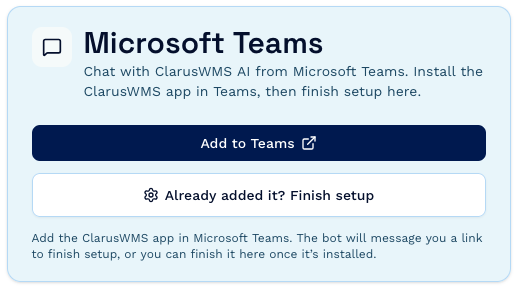
2
Add it in Teams
- Just for you, or a small pilot
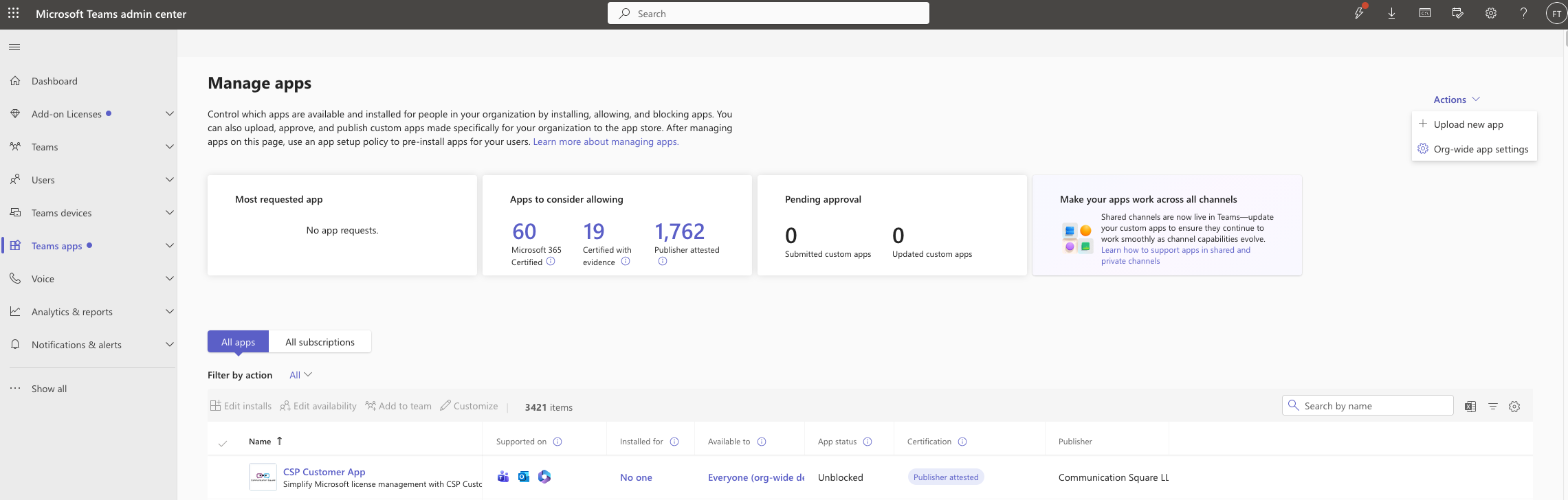
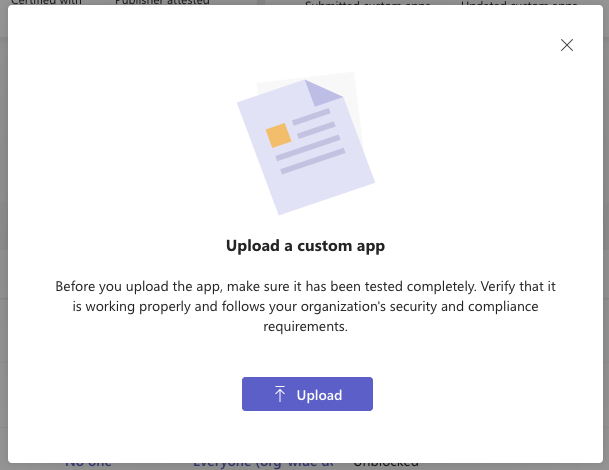
- For your whole organisation
- In Teams, go to Apps in the left sidebar.
- Click Manage your apps at the bottom.
- Click Upload an app, then Upload a custom app.
- Choose the ClarusWMS app package, then click Add.
If Upload a custom app is missing or greyed out, your organisation hasn’t allowed it. A Teams administrator can enable it under Teams admin centre → Teams apps → Setup policies → Upload custom apps, or use the organisation-wide route instead.
3
Choose where it lives
Add ClarusWMS to whichever of these you need — you can do both:
- A personal chat, for one-to-one questions.
- A team or channel, so a group can ask it things together. Choose Add to a team and pick the channel.
Stage 2 — Link it to Clarus
As soon as the app is added, the ClarusWMS bot sends you a direct message in Teams with a link to finish setup. That link already knows which Microsoft organisation you’re in, so it’s much the easiest route.
1
Open the setup link
Click the link in the bot’s message. If you’re not already signed in to Clarus, you’ll be asked to sign in, and to choose which organisation you’re setting up — you’ll come straight back to the setup screen afterwards.
2
Check the Microsoft organisation
The Microsoft tenant field is filled in and locked, taken from the link. That’s what identifies your Microsoft organisation, and there’s nothing to change.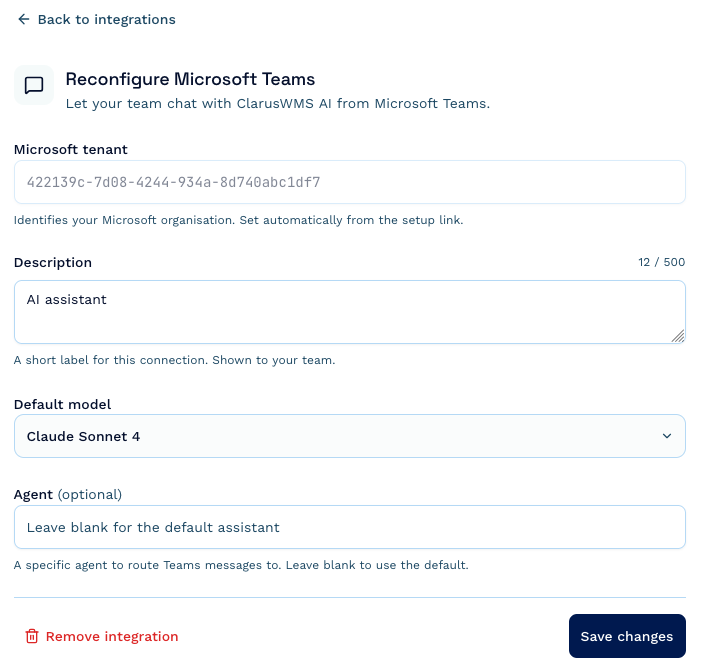
3
Describe the connection and connect
- Description — required. A short label such as
Acme Logistics warehouse assistant. - Default model — leave as Sonnet unless you have a reason to change it.
- Agent — optional. Leave blank to use the default assistant.
If you don’t have the bot’s message
Someone other than you may have added the app. You can finish setup from the AI app instead:- Go to Settings → Integrations and, on the Microsoft Teams card, click Already added it? Finish setup.
- Enter your Microsoft tenant — your Microsoft organisation’s ID. It’s in the ClarusWMS bot’s welcome message, or your Microsoft admin centre. It looks like either
contoso.onmicrosoft.comor a long ID made of letters, numbers, and hyphens. - Fill in the description and model as above, then click Connect Teams.
Using it in Teams
In a personal chat, every message you send goes to the assistant, and the chat stays one continuous conversation:You: which goods out orders for Acme are still unpicked?In a channel or group chat, the assistant only responds when you @mention it, so it stays quiet during normal team chat:
@ClarusAI how many pallets of WIDGET-RED-500 are left?
Files aren’t supported on Teams yet. Attachments sent in Teams aren’t read — ask your question in text, or use Slack or WhatsApp where you need to send a document or photo.
Notifications. Clarus can post alerts into a Teams conversation, but only one it has already been part of. Message the bot — or @mention it in the channel — once, and it can post there from then on.
Long answers arrive as more than one message.
Change your settings
On the Microsoft Teams card in Settings → Integrations, click Reconfigure to change the description, default model, or agent.Remove the integration
On the connect screen, click Remove integration and confirm. Your team can no longer message the assistant from Teams, and you can reconnect later. The ClarusWMS app itself stays installed in your Microsoft organisation — to take it out of Teams entirely, remove it in Teams or the Teams admin centre as well.Troubleshooting
The bot says the workspace isn't linked to a ClarusWMS account
The bot says the workspace isn't linked to a ClarusWMS account
Stage 1 is done but Stage 2 isn’t — the app is in Teams but hasn’t been linked to your Clarus account. A Clarus administrator needs to complete the link, either from the bot’s setup link or via Settings → Integrations → Already added it? Finish setup.
Teams says 'We can't read the manifest file'
Teams says 'We can't read the manifest file'
The app package has been altered — most often unzipped and re-zipped, which nests the files inside a folder. Use the original package exactly as supplied, without opening or re-compressing it. If it still fails with an untouched package, contact Clarus support.
I can't find 'Upload a custom app'
I can't find 'Upload a custom app'
Your organisation hasn’t allowed custom app upload. A Teams administrator can enable it under Teams admin centre → Teams apps → Setup policies → Upload custom apps, or add ClarusWMS organisation-wide via Teams apps → Manage apps → Upload new app.
'This Microsoft tenant is already connected to another ClarusWMS account'
'This Microsoft tenant is already connected to another ClarusWMS account'
A Microsoft organisation can be connected to one Clarus account at a time. Someone has already linked it to a different Clarus account and needs to remove that connection before you can create yours.
The bot ignores messages in a channel
The bot ignores messages in a channel
In channels and group chats the assistant only replies when it’s @mentioned — this is deliberate, so it doesn’t read everything your team says. Start your message with
@ClarusAI. Personal chats always work without a mention.Alerts aren't arriving in our channel
Alerts aren't arriving in our channel
Clarus can only post into a Teams conversation it has already been part of. @mention the bot in that channel once, then alerts can be delivered there.
What is a Microsoft tenant ID and where do I find it?
What is a Microsoft tenant ID and where do I find it?
It identifies your Microsoft organisation. The quickest source is the ClarusWMS bot’s welcome message in Teams, which contains a setup link with it already included. Otherwise a Microsoft administrator can find it in the Microsoft Entra admin centre — it’s shown as either your
onmicrosoft.com domain or a long ID made of letters, numbers, and hyphens.